

Chapter four of The Artist’s Way is about recovering a sense of integrity.
Cameron invites us into a new level of self-awareness, beginning with honesty about how we feel about our creative journey, our talents, and our purpose.
The morning pages provide a space for us to show up with radical honesty and identify where we may feel out of alignment with our true selves. Here, honesty also means excavating buried dreams—hobbies we have set aside as impractical, interests we have deemed unrealistic or childish, activities we used to enjoy just for fun that we might like to try once again.
How we see ourselves, what we believe we are capable of, and whether we see art and the artistic self as a hobby rather than a calling all impact how we show up in the world.
Part of the calculus, the code we all seek to crack, is the mistaken belief that our worthiness depends on the validation of our peers. We come to value being seen as professional more than experiencing joy, peace, and love.
We call it sacrifice when we pursue professional endeavors at the expense of the people and experiences that make life meaningful.
But what are we losing in the process, and is it worth it?
From the Pages
In the fifth week of daily morning pages, the entry that stood out was not about a writing project or a class lecture. It was a question:
Who am I?
How much of who I understand myself to be has been externally imposed, and how much emanates from within? As a scholar, am I studying what I truly desire to know, or simply the topics I believe will make me sound impressive when I speak from the lectern?
Who I am as an academic is an amalgamation of different versions of myself, each carrying its own imposter syndrome, inner traumas, and uncertainties, all stitched together into something I believe is remarkable, or at best, true.
But even my chosen profession sometimes leaves me feeling uncertain. Am I someone who has settled, who has simply imposed limitations on himself? Someone who has come to believe that his job is to teach law, while his hobby and passion on the side are writing creatively and reading literature?
What if all of that is wrong?
A couple of weeks later, I found myself writing about money and reflecting on high school. As a kid, I remember thinking I wanted to pursue art or some other creative path. I either heard it directly or understood it indirectly: art doesn’t pay. It is not a realistic career path, especially for a kid as smart as me. “You should be a doctor,” I was told. I don’t know how much I believed that, but I do know that I came to view art as a hobby, something to do for fun rather than something to pursue as a full-time career.
In high school, I was steered toward engineering, which seemed to make sense at the time. And I think it was, in fact, the right decision. I was good at math and science, enjoyed art class, and liked problem-solving. I tried to learn art in various ways, but it wasn’t something the adults in my life invested in. It felt less visible, more hidden. More hobby than talent. But it was always there in the background: break dancing, aggressive inline skating, graffiti art, poetry, competing on the speech team performing drama pieces, a hunger to express myself creatively.
My father came to this country as a young adult, seeking a better life. He was a creative who did not live a life devoted to artistic creation. Instead, he sacrificed, working jobs that I’m sure he did not love but that allowed him to provide for his family. He was immensely smart, but never attained formal recognition for it. He was talented at drawing, but never really pursued it beyond the occasional hobby sketch or model project. He loved solving puzzles, but could not solve the puzzle of building a life committed to creative discovery while also providing for his family.
And so he sacrificed.
He valued order, structure, and timeliness, yet he craved music, art, comics, puzzles, games, and nature. I think he was trying to resolve how to express a creative instinct while living within a survival mentality, where one must bear certain responsibilities that can make play seem impossible.
The Shelf
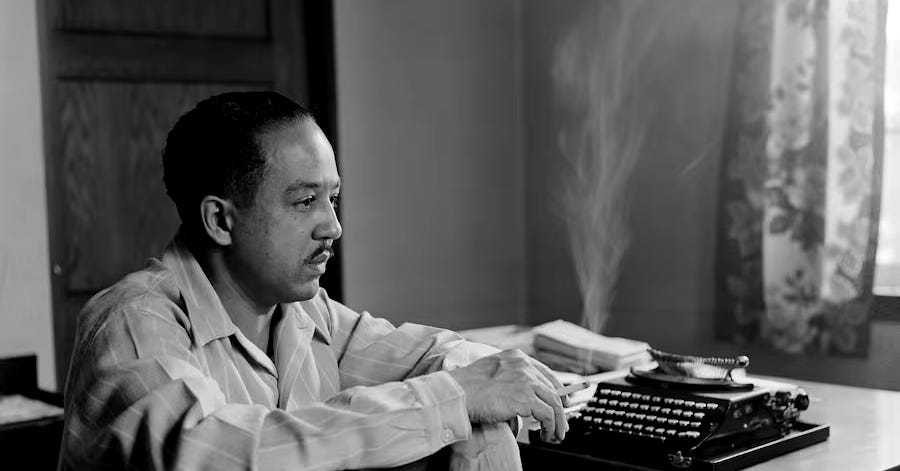
Langston Hughes wrote “The Negro Artist and the Racial Mountain” in the 1920s, during the Harlem Renaissance, when Black artists and creatives were flourishing despite the nation’s long history of White supremacy, Jim Crow segregation, and racial discrimination.
He responds to a young Black poet who says, “I want to be a poet—not a Negro poet.” To Hughes, the desire not to be an artist associated with the Black race, but instead to transcend it, reflects what he calls the racial mountain. At its core, he argues, is an urge to be White.
Hughes describes the young poet as coming from a middle-class Black neighborhood, where respectability politics, internalized racism, and shame can lead people to disregard their own cultural beauty and uniqueness in favor of White ideals of success, belonging, and beauty. In contrast, Hughes praises working-class Black people who enjoy being among their own and take pride in their jazz, their spirituals, their native dialect, and other cultural expressions that do not align with the White status quo.
Yet the Black artist still faces criticism and misunderstanding within their own community, not to mention a broader White society that wants to capitalize on and profit from their creative production. There remains pressure to conform, to be respectable, and to avoid shattering the illusions society holds about Black people, illusions that help sustain the racial status quo and its hierarchy.
Hughes himself had been asked why he always writes about Black folks. I found this ironic because Toni Morrison was asked the very same question decades later in an interview about her novels. She described it as an incredulous question, racist at its core, because telling stories about Black people without centering the White gaze was viewed as countercultural.
Hughes describes the Black artist as bearing a duty. The younger artist who embraces jazz and infuses it into his work helps inspire pride in Blackness among other Black people and in society more broadly. In doing so, the artist challenges the shame of those who seek to avoid their own Blackness. Hughes says that he and other Black artists of the Harlem Renaissance know they are beautiful, and know they are ugly too. They stand on top of the mountain and declare it, free within themselves, for all to see.
To be sure, there is a sense in which we sometimes feel ashamed of wanting a life that runs counter to the status quo, particularly when that life does not offer the material resources and comforts that society teaches us to value. For my parents, however, and for my father, in particular, I do not believe shame was the driving force behind what they did or did not pursue. It was survival that governed the calculation for them as working-class immigrants in late twentieth-century America.
Can you pursue art when you have to put food on the table, pay school tuition, and help take care of aging parents?
This is even more true when you come from a working-class background and are also the child of Black immigrants. The cards are seemingly stacked against you. What is called for, then, is the pursuit of safer pathways toward stability: excelling in school to secure a stable job rather than pursuing the entrepreneurial life of the artist, which brings far more uncertainty.
If one wants to be an artist, the only way to meet that pressure and overcome that risk is to be great. To be a great artist. But that sets one up for great fear, because that hill is steep.
And great fear is often enough to keep talent merely as a hobby.
The Valley
Still, it is easy to stand on top of the mountain when no one is waiting for you at the bottom, in the valley, in the dark place, in the shadow.
I believe Hughes underestimates the tension the young Black artists faces, especially in Jim Crow America, where they faced not merely racial discrimination but, in many instances, the threat of physical death from racial terrorism. Notwithstanding the civil rights movement, many of those same tensions remain today across our country. Some may still feel an urge to be embraced as equals by their White peers, to transcend their Blackness, as if they are not already worthy of dignity.
For others, however, there is a desire to be an artist, to express their divinity through their artistic production, to become a vessel for God’s voice to speak into the void.
There is a desire to be that, and yet also a need to survive the limitations of White supremacy that govern how their art is perceived and received in a racialized world. A desire to be seen as fully human in a world where Blackness itself brings certain assumptions, biases, and prejudices about their capability, their value, their worthiness.
Cameron treats honesty as if it concerns only an inner critic, a voice we can silence through greater self-awareness. Hughes argues that the noise arises from outside too—from judgmental or overprotective parents, from biases and assumptions imposed by a society preoccupied with race, and from class dynamics that establish social hierarchies.
And outside voices are much harder to silence.
They can limit one’s understanding of not only who one is, but who one can become. This ultimately speaks to the question of legitimacy. What does it mean to be an artist when society places limits on who can be an artist to begin with, based on characteristics that cannot be changed?
That mountain is incredibly steep.
And so there is indeed a fear, as Cameron herself notes, but a fear of abandonment not by parents, but by society itself. A fear of losing social esteem, which is arguably necessary to forge an integrated sense of self in a multicultural society.
Race adds nuance to the question of integrity, the question of honesty. To the role fear plays in the artist’s search for authenticity. To the need for compassion.
Perhaps that compassion begins with learning to give the artist within us the love we have so often waited for from without.
To make room for that part of ourselves, to nurture it, and to let it create.
Becoming Full,

A Note to Reader: Chapter Five of The Artist’s Way is about recovering a sense of possibility. In my syllabus, I’m reading it alongside Octavia Butler’s essay “Positive Obsession,” which explores the discipline, curiosity, and commitment that sustain a creative life. See you next time.
P.S. As always, thank you for reading this week’s issue of The Tenure Track. If you found this article helpful, share it with a friend. If it moved you, consider supporting with a paid subscription or buying me a coffee. Together, let’s continue to build a supportive and creative academic community.
Your support helps me create content that serves fellow scholars on the path.